
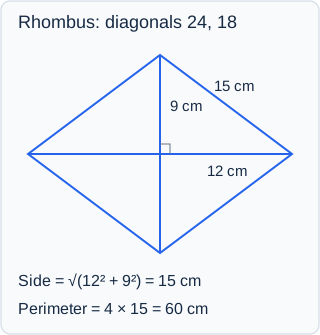
The area of a rhombus is 216 cm² and its one of the diagonals is 24 cm. Then its perimeter is –
Area of a rhombus \(= \frac{1}{2} d_1 d_2 = 216\text{ cm}^2\). Since \(d_1 = 24\text{ cm}\), we get \(\frac{1}{2} \times 24 \times d_2 = 216 \implies d_2 = 18\text{ cm}\).…
Choose your answer
The area of a rhombus is 216 cm² and its one of the diagonals is 24 cm. Then its perimeter is –
Answer and explanation
Correct answer C
Area of a rhombus . Since , we get . The diagonals bisect each other at right angles with half-lengths and , so each side is . Therefore, perimeter .
Practice for these exams
-
Rajasthan Jailor