
JIPMAT 2024 Question Paper with Answers
Try practice questions from JIPMAT 2024 and check your answers. The preview order may differ from the original paper.
Question 1
In the following question a statement is given, followed by two conclusions. You have to assume everything in the statement to be true, then consider the two conclusions together and decide which of them logically follows beyond reasonable doubt from the given information.
Statement: The use of non-conventional sources of energy will eliminate the energy crisis in the world.
Conclusion I: Modern technology is gradually replacing the conventional source of energy.
Conclusion II: The excessive exploitation of environment has led to the depletion of conventional source of energy.
Question 2
A speaks truth in 75% of cases and B in 80% of the cases. In what percentage of cases are they likely to contradict each other, narrating the same incident?
Question 3
A watch which gains uniformly is 2 minutes slow at 10:00 AM on Monday and is minutes fast at 1:00 PM the following day. When did it show the correct time?
Question 4
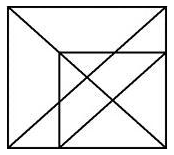
Find the number of triangles in the following figure.
Question 5
Ultra vires means:
Question 6
Pointing to a photograph, a woman says, “This man’s son’s sister is my mother-in-law.” How is the woman’s husband related to the man in the photograph?
Question 7
If a person travels three equal distances at a speed of x km/hr, y km/hr and z km/hr respectively, then the average speed during the whole journey is -
Question 8
| Digit | 8 | 3 | 0 | 7 | 4 | 6 | 9 | 2 | 5 | 1 |
|---|---|---|---|---|---|---|---|---|---|---|
| Code | ₹ | H | R | A | M | % | L | K | E | # |
Exception I:
If a number begins and ends with a non-zero odd digit, then the first and last digits are to be coded as Y and * respectively.
Exception II:
If a number begins and ends with an even digit (including zero), then the first and last digits are to be coded as β and X respectively.
Which of the following numbers can the code YH₹ME* represent?
- (I) 138450
- (II) 338457
- (III) 538459
- (IV) 438458
Question 9
AFHO : GBDJ : : CHFM : ?
Question 10
Question 11
Question 12
.
Question 13
Question 14
(I) The number of smaller cubes with two surfaces painted is 36.
(II) The number of smaller cubes with one surface painted is 24.
(III) The number of smaller cubes with no surface painted is 8.
(IV) The number of smaller cubes with at least two surfaces painted is 30.
Question 15
Question 16
| Item of Expenditure | Expenditure (in ₹ Thousands) | |||||
|---|---|---|---|---|---|---|
| 2011 | 2012 | 2013 | 2014 | 2015 | Total | |
| Food | 800 | 900 | 1050 | 1200 | 1400 | 5350 |
| House Rent | 150 | 150 | 210 | 240 | 300 | 1050 |
| Clothing | 75 | 100 | 130 | 170 | 250 | 725 |
| Fuel and Electricity | 30 | 40 | 50 | 60 | 70 | 250 |
| Education | 150 | 170 | 200 | 260 | 300 | 1080 |
| Medical Expenses | 75 | 90 | 100 | 110 | 150 | 525 |
| Miscellaneous | 220 | 250 | 260 | 360 | 430 | 1520 |
| Total | 1500 | 1700 | 2000 | 2400 | 2900 | 10500 |
What is the percentage increase in expenditure on education during 2011 to 2015 ?
Question 17
| Item of Expenditure | Expenditure (in ₹ Thousands) | |||||
|---|---|---|---|---|---|---|
| 2011 | 2012 | 2013 | 2014 | 2015 | Total | |
| Food | 800 | 900 | 1050 | 1200 | 1400 | 5350 |
| House Rent | 150 | 150 | 210 | 240 | 300 | 1050 |
| Clothing | 75 | 100 | 130 | 170 | 250 | 725 |
| Fuel and Electricity | 30 | 40 | 50 | 60 | 70 | 250 |
| Education | 150 | 170 | 200 | 260 | 300 | 1080 |
| Medical Expenses | 75 | 90 | 100 | 110 | 150 | 525 |
| Miscellaneous | 220 | 250 | 260 | 360 | 430 | 1520 |
| Total | 1500 | 1700 | 2000 | 2400 | 2900 | 10500 |
In the light of the total expenditure for 2011, 2012, 2013, 2014 and 2015, what will be the likely expenditure in 2016 ?
Question 18
Question 19
| Item of Expenditure | Expenditure (in ₹ Thousands) | |||||
|---|---|---|---|---|---|---|
| 2011 | 2012 | 2013 | 2014 | 2015 | Total | |
| Food | 800 | 900 | 1050 | 1200 | 1400 | 5350 |
| House Rent | 150 | 150 | 210 | 240 | 300 | 1050 |
| Clothing | 75 | 100 | 130 | 170 | 250 | 725 |
| Fuel and Electricity | 30 | 40 | 50 | 60 | 70 | 250 |
| Education | 150 | 170 | 200 | 260 | 300 | 1080 |
| Medical Expenses | 75 | 90 | 100 | 110 | 150 | 525 |
| Miscellaneous | 220 | 250 | 260 | 360 | 430 | 1520 |
| Total | 1500 | 1700 | 2000 | 2400 | 2900 | 10500 |
Considering the total expenditure for all the five years together, what is the percentage expenditure on house rent ?
Question 20
Continue practising
The practice pack for JIPMAT is coming soon to LawMint.net.