
West Bengal SET (WB SET) Non-law sections Previous Year Questions
Try the preview and open any solution for a worked explanation.
West Bengal SET (WB SET) practice pack
The practice pack for West Bengal SET (WB SET) is coming soon to LawMint.
Question 1
It must be stressed that there are numerous cases in which having more information has indeed enabled humans to understand the world better and to make wiser use of their power. Consider, for example, the dramatic reduction in child mortality.
Johann Wolfgang von Goethe went on to have five children of his own, of whom all but the eldest son—August—died within two weeks of their birth. In all probability the cause was incompatibility between the blood groups of Goethe and his wife, Christiane, which after the first successful pregnancy led the mother to develop antibodies to the fetal blood. This condition, known as rhesus disease, is nowadays treated so effectively that the mortality rate is less than 2 percent, but in the 1790s it had an average mortality rate of 50 percent and for Goethe’s four younger children it was a death sentence.
Altogether in Goethe’s family—a well-to-do German family in the late eighteenth century—the child survival rate was an abysmal 25 percent. Only three out of twelve children reached adulthood. This horrendous statistic was not exceptional. Around the time Goethe wrote “The Sorcerer’s Apprentice” in 1797, it is estimated that only about 50 percent of German children reached age fifteen, and the same was probably true in most other parts of the world. By 2020, 95.6 percent of children worldwide lived beyond their fifteenth birthday, and in Germany that figure was 99.5 per cent. This momentous achievement would not have been possible without collecting, analyzing, and sharing massive amounts of medical data about things like blood groups. In this case, then, the naive view of information proved to be correct.
However, the naive view of information sees only part of the picture, and the history of the modern age was not just about reducing child mortality. In recent generations humanity has experienced the greatest increase ever in both the amount and the speed of our information production. Every smartphone contains more information than the ancient Library of Alexandria and enables its owner to instantaneously connect to billions of other people throughout the world. Yet with all this information circulating at breathtaking speeds, humanity is closer than ever to annihilating itself.
What does the author consider information to be in the passage?
Question 2
It must be stressed that there are numerous cases in which having more information has indeed enabled humans to understand the world better and to make wiser use of their power. Consider, for example, the dramatic reduction in child mortality.
Johann Wolfgang von Goethe went on to have five children of his own, of whom all but the eldest son—August—died within two weeks of their birth. In all probability the cause was incompatibility between the blood groups of Goethe and his wife, Christiane, which after the first successful pregnancy led the mother to develop antibodies to the fetal blood. This condition, known as rhesus disease, is nowadays treated so effectively that the mortality rate is less than 2 percent, but in the 1790s it had an average mortality rate of 50 percent and for Goethe’s four younger children it was a death sentence.
Altogether in Goethe’s family—a well-to-do German family in the late eighteenth century—the child survival rate was an abysmal 25 percent. Only three out of twelve children reached adulthood. This horrendous statistic was not exceptional. Around the time Goethe wrote “The Sorcerer’s Apprentice” in 1797, it is estimated that only about 50 percent of German children reached age fifteen, and the same was probably true in most other parts of the world. By 2020, 95.6 percent of children worldwide lived beyond their fifteenth birthday, and in Germany that figure was 99.5 per cent. This momentous achievement would not have been possible without collecting, analyzing, and sharing massive amounts of medical data about things like blood groups. In this case, then, the naive view of information proved to be correct.
However, the naive view of information sees only part of the picture, and the history of the modern age was not just about reducing child mortality. In recent generations humanity has experienced the greatest increase ever in both the amount and the speed of our information production. Every smartphone contains more information than the ancient Library of Alexandria and enables its owner to instantaneously connect to billions of other people throughout the world. Yet with all this information circulating at breathtaking speeds, humanity is closer than ever to annihilating itself.
According to the passage, in whose blood do the antibodies that cause rhesus disease originate?
Question 3
It must be stressed that there are numerous cases in which having more information has indeed enabled humans to understand the world better and to make wiser use of their power. Consider, for example, the dramatic reduction in child mortality.
Johann Wolfgang von Goethe went on to have five children of his own, of whom all but the eldest son—August—died within two weeks of their birth. In all probability the cause was incompatibility between the blood groups of Goethe and his wife, Christiane, which after the first successful pregnancy led the mother to develop antibodies to the fetal blood. This condition, known as rhesus disease, is nowadays treated so effectively that the mortality rate is less than 2 percent, but in the 1790s it had an average mortality rate of 50 percent and for Goethe’s four younger children it was a death sentence.
Altogether in Goethe’s family—a well-to-do German family in the late eighteenth century—the child survival rate was an abysmal 25 percent. Only three out of twelve children reached adulthood. This horrendous statistic was not exceptional. Around the time Goethe wrote “The Sorcerer’s Apprentice” in 1797, it is estimated that only about 50 percent of German children reached age fifteen, and the same was probably true in most other parts of the world. By 2020, 95.6 percent of children worldwide lived beyond their fifteenth birthday, and in Germany that figure was 99.5 per cent. This momentous achievement would not have been possible without collecting, analyzing, and sharing massive amounts of medical data about things like blood groups. In this case, then, the naive view of information proved to be correct.
However, the naive view of information sees only part of the picture, and the history of the modern age was not just about reducing child mortality. In recent generations humanity has experienced the greatest increase ever in both the amount and the speed of our information production. Every smartphone contains more information than the ancient Library of Alexandria and enables its owner to instantaneously connect to billions of other people throughout the world. Yet with all this information circulating at breathtaking speeds, humanity is closer than ever to annihilating itself.
According to the passage, the effective treatment of children afflicted with rhesus disease has reduced the mortality rate to what level?
Question 4
It must be stressed that there are numerous cases in which having more information has indeed enabled humans to understand the world better and to make wiser use of their power. Consider, for example, the dramatic reduction in child mortality.
Johann Wolfgang von Goethe went on to have five children of his own, of whom all but the eldest son—August—died within two weeks of their birth. In all probability the cause was incompatibility between the blood groups of Goethe and his wife, Christiane, which after the first successful pregnancy led the mother to develop antibodies to the fetal blood. This condition, known as rhesus disease, is nowadays treated so effectively that the mortality rate is less than 2 percent, but in the 1790s it had an average mortality rate of 50 percent and for Goethe’s four younger children it was a death sentence.
Altogether in Goethe’s family—a well-to-do German family in the late eighteenth century—the child survival rate was an abysmal 25 percent. Only three out of twelve children reached adulthood. This horrendous statistic was not exceptional. Around the time Goethe wrote “The Sorcerer’s Apprentice” in 1797, it is estimated that only about 50 percent of German children reached age fifteen, and the same was probably true in most other parts of the world. By 2020, 95.6 percent of children worldwide lived beyond their fifteenth birthday, and in Germany that figure was 99.5 per cent. This momentous achievement would not have been possible without collecting, analyzing, and sharing massive amounts of medical data about things like blood groups. In this case, then, the naive view of information proved to be correct.
However, the naive view of information sees only part of the picture, and the history of the modern age was not just about reducing child mortality. In recent generations humanity has experienced the greatest increase ever in both the amount and the speed of our information production. Every smartphone contains more information than the ancient Library of Alexandria and enables its owner to instantaneously connect to billions of other people throughout the world. Yet with all this information circulating at breathtaking speeds, humanity is closer than ever to annihilating itself.
The dramatic and positive achievement of medical treatment was made possible by:
Question 5
It must be stressed that there are numerous cases in which having more information has indeed enabled humans to understand the world better and to make wiser use of their power. Consider, for example, the dramatic reduction in child mortality.
Johann Wolfgang von Goethe went on to have five children of his own, of whom all but the eldest son—August—died within two weeks of their birth. In all probability the cause was incompatibility between the blood groups of Goethe and his wife, Christiane, which after the first successful pregnancy led the mother to develop antibodies to the fetal blood. This condition, known as rhesus disease, is nowadays treated so effectively that the mortality rate is less than 2 percent, but in the 1790s it had an average mortality rate of 50 percent and for Goethe’s four younger children it was a death sentence.
Altogether in Goethe’s family—a well-to-do German family in the late eighteenth century—the child survival rate was an abysmal 25 percent. Only three out of twelve children reached adulthood. This horrendous statistic was not exceptional. Around the time Goethe wrote “The Sorcerer’s Apprentice” in 1797, it is estimated that only about 50 percent of German children reached age fifteen, and the same was probably true in most other parts of the world. By 2020, 95.6 percent of children worldwide lived beyond their fifteenth birthday, and in Germany that figure was 99.5 per cent. This momentous achievement would not have been possible without collecting, analyzing, and sharing massive amounts of medical data about things like blood groups. In this case, then, the naive view of information proved to be correct.
However, the naive view of information sees only part of the picture, and the history of the modern age was not just about reducing child mortality. In recent generations humanity has experienced the greatest increase ever in both the amount and the speed of our information production. Every smartphone contains more information than the ancient Library of Alexandria and enables its owner to instantaneously connect to billions of other people throughout the world. Yet with all this information circulating at breathtaking speeds, humanity is closer than ever to annihilating itself.
What conclusion does the author draw about the future of the human race?
Question 6
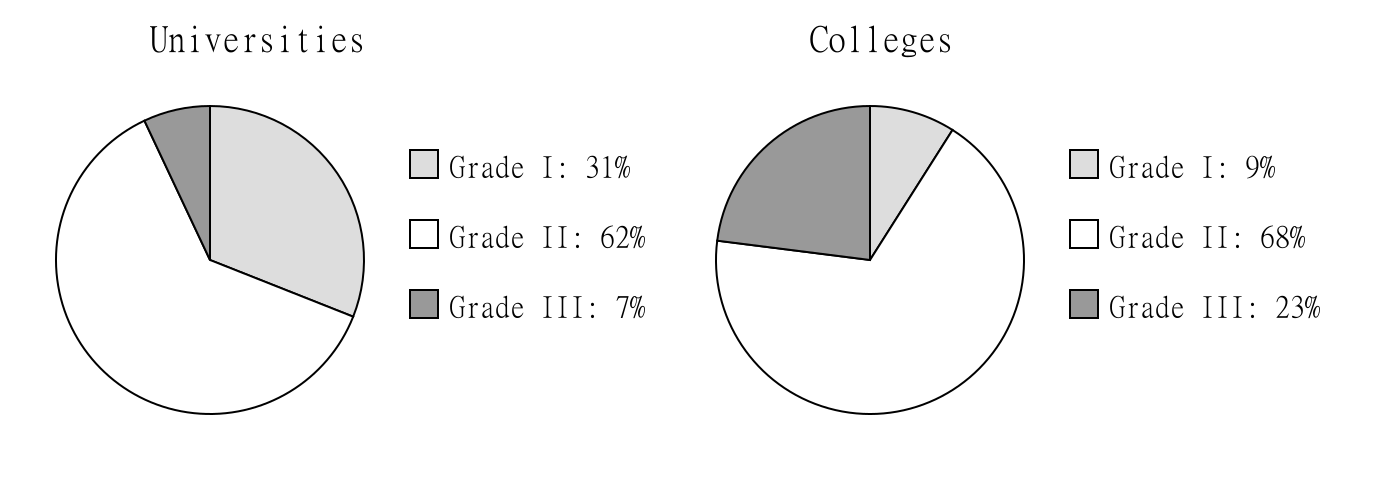
A certain country has 504 universities and 25951 colleges. These are categorised into Grades I, II, and III as shown in the given pie charts.
What is the percentage, correct to one decimal place, of higher education institutions (colleges and universities) that falls into Grade III?
Question 7
Today the revolution in biology that began with the discovery of genes more than a hundred years ago has led us to a crossroads. For the first time, recent research on the fundamental causes of aging is raising the prospect not merely of improving our health in old age but also of extending human life span.
Demographics is driving a huge effort to identify the causes of aging and to find ways to ameliorate its effects. Much of the world is faced with a growing elderly population, and keeping them healthy for as long as possible has become an urgent social imperative. The result is that after a long period in which it was a scientific backwater, aging research—or gerontology—has taken off.
In the last ten years alone, more than 300,000 scientific articles on aging have been published. More than 700 start-up companies have invested a combined many tens of billions of dollars to tackle aging—and this is not counting large, established pharmaceutical companies that have programs of their own.
This enormous effort raises a number of questions. Could we eventually cheat disease and death and live for a very long time, possibly many times our current life span? Certainly some scientists make that claim. And California billionaires, who love their lifestyles and don’t want the party to end, are only too willing to fund them.
The immortality merchants of today—the researchers who propose trying to extend life indefinitely and the billionaires who fund them—are really a modern take on the prophets of old, promising a long life largely free of the fear of encroaching old age and death. Who would have this life? The tiny fraction of the population who could afford it? What would be the ethics of treating or modifying humans to achieve this? And if it becomes widely available, what sort of society would we have? Would we be sleepwalking into a future without considering the potential social, economic, and political consequences of humans living well beyond our current life spans? Given recent advances and the enormous amount of money pouring into aging research, we must ask where this research is leading us, as well as what it suggests about the limits of human beings.
The coronavirus pandemic that hit the world in late 2019 is a stark reminder that nature does not care about our plans. Life on Earth is governed by evolution, and we are yet again reminded that viruses have been here long before humans, are highly adaptable, and will be here long after we are gone. Is it arrogant to think that we can cheat death using science and technology? If it is, what should our goals be instead?
What prospect is raised by recent research in Biology?
Question 8
Today the revolution in biology that began with the discovery of genes more than a hundred years ago has led us to a crossroads. For the first time, recent research on the fundamental causes of aging is raising the prospect not merely of improving our health in old age but also of extending human life span.
Demographics is driving a huge effort to identify the causes of aging and to find ways to ameliorate its effects. Much of the world is faced with a growing elderly population, and keeping them healthy for as long as possible has become an urgent social imperative. The result is that after a long period in which it was a scientific backwater, aging research—or gerontology—has taken off.
In the last ten years alone, more than 300,000 scientific articles on aging have been published. More than 700 start-up companies have invested a combined many tens of billions of dollars to tackle aging—and this is not counting large, established pharmaceutical companies that have programs of their own.
This enormous effort raises a number of questions. Could we eventually cheat disease and death and live for a very long time, possibly many times our current life span? Certainly some scientists make that claim. And California billionaires, who love their lifestyles and don’t want the party to end, are only too willing to fund them.
The immortality merchants of today—the researchers who propose trying to extend life indefinitely and the billionaires who fund them—are really a modern take on the prophets of old, promising a long life largely free of the fear of encroaching old age and death. Who would have this life? The tiny fraction of the population who could afford it? What would be the ethics of treating or modifying humans to achieve this? And if it becomes widely available, what sort of society would we have? Would we be sleepwalking into a future without considering the potential social, economic, and political consequences of humans living well beyond our current life spans? Given recent advances and the enormous amount of money pouring into aging research, we must ask where this research is leading us, as well as what it suggests about the limits of human beings.
The coronavirus pandemic that hit the world in late 2019 is a stark reminder that nature does not care about our plans. Life on Earth is governed by evolution, and we are yet again reminded that viruses have been here long before humans, are highly adaptable, and will be here long after we are gone. Is it arrogant to think that we can cheat death using science and technology? If it is, what should our goals be instead?
Gerontology is the:
Question 9
Today the revolution in biology that began with the discovery of genes more than a hundred years ago has led us to a crossroads. For the first time, recent research on the fundamental causes of aging is raising the prospect not merely of improving our health in old age but also of extending human life span.
Demographics is driving a huge effort to identify the causes of aging and to find ways to ameliorate its effects. Much of the world is faced with a growing elderly population, and keeping them healthy for as long as possible has become an urgent social imperative. The result is that after a long period in which it was a scientific backwater, aging research—or gerontology—has taken off.
In the last ten years alone, more than 300,000 scientific articles on aging have been published. More than 700 start-up companies have invested a combined many tens of billions of dollars to tackle aging—and this is not counting large, established pharmaceutical companies that have programs of their own.
This enormous effort raises a number of questions. Could we eventually cheat disease and death and live for a very long time, possibly many times our current life span? Certainly some scientists make that claim. And California billionaires, who love their lifestyles and don’t want the party to end, are only too willing to fund them.
The immortality merchants of today—the researchers who propose trying to extend life indefinitely and the billionaires who fund them—are really a modern take on the prophets of old, promising a long life largely free of the fear of encroaching old age and death. Who would have this life? The tiny fraction of the population who could afford it? What would be the ethics of treating or modifying humans to achieve this? And if it becomes widely available, what sort of society would we have? Would we be sleepwalking into a future without considering the potential social, economic, and political consequences of humans living well beyond our current life spans? Given recent advances and the enormous amount of money pouring into aging research, we must ask where this research is leading us, as well as what it suggests about the limits of human beings.
The coronavirus pandemic that hit the world in late 2019 is a stark reminder that nature does not care about our plans. Life on Earth is governed by evolution, and we are yet again reminded that viruses have been here long before humans, are highly adaptable, and will be here long after we are gone. Is it arrogant to think that we can cheat death using science and technology? If it is, what should our goals be instead?
What proves that gerontology has become a vibrant area of research in Biology?
Question 10
Today the revolution in biology that began with the discovery of genes more than a hundred years ago has led us to a crossroads. For the first time, recent research on the fundamental causes of aging is raising the prospect not merely of improving our health in old age but also of extending human life span.
Demographics is driving a huge effort to identify the causes of aging and to find ways to ameliorate its effects. Much of the world is faced with a growing elderly population, and keeping them healthy for as long as possible has become an urgent social imperative. The result is that after a long period in which it was a scientific backwater, aging research—or gerontology—has taken off.
In the last ten years alone, more than 300,000 scientific articles on aging have been published. More than 700 start-up companies have invested a combined many tens of billions of dollars to tackle aging—and this is not counting large, established pharmaceutical companies that have programs of their own.
This enormous effort raises a number of questions. Could we eventually cheat disease and death and live for a very long time, possibly many times our current life span? Certainly some scientists make that claim. And California billionaires, who love their lifestyles and don’t want the party to end, are only too willing to fund them.
The immortality merchants of today—the researchers who propose trying to extend life indefinitely and the billionaires who fund them—are really a modern take on the prophets of old, promising a long life largely free of the fear of encroaching old age and death. Who would have this life? The tiny fraction of the population who could afford it? What would be the ethics of treating or modifying humans to achieve this? And if it becomes widely available, what sort of society would we have? Would we be sleepwalking into a future without considering the potential social, economic, and political consequences of humans living well beyond our current life spans? Given recent advances and the enormous amount of money pouring into aging research, we must ask where this research is leading us, as well as what it suggests about the limits of human beings.
The coronavirus pandemic that hit the world in late 2019 is a stark reminder that nature does not care about our plans. Life on Earth is governed by evolution, and we are yet again reminded that viruses have been here long before humans, are highly adaptable, and will be here long after we are gone. Is it arrogant to think that we can cheat death using science and technology? If it is, what should our goals be instead?
What are the consequences the author foresees about research on old age and extension of life span?
Non-law sections subtopics in West Bengal SET (WB SET) papers
Previous papers with Non-law sections questions
West Bengal SET (WB SET) practice pack
The practice pack for West Bengal SET (WB SET) is coming soon to LawMint.