
Telangana SET (TG SET) Data Structures and Algorithms Previous Year Questions
Try the preview and open any solution for a worked explanation.
Telangana SET (TG SET) practice pack
The practice pack for Telangana SET (TG SET) is coming soon to LawMint.
Question 1
Which of the following correctly lists the functions in increasing order of their asymptotic growth rates as ?
Question 2
Consider the following recurrence relation: \(= \begin{cases} 0, & \text{if } n\) \(= 0 \\ 2f(n-1) + 1, & \text{if } n\) \(> 0 \end{cases}\)
What is the asymptotic time complexity of f(n)?
Question 3
Consider the algorithms and computational problems listed in List I and their corresponding algorithmic design strategies listed in List II.
| List I (Algorithm/Problem) | List II (Algorithm Design Strategy) |
|---|---|
| a. Merge Sort | i. Divide and conquer |
| b. 0/1 Knapsack | ii. Dynamic Programming |
| c. Prim's Algorithm for finding Minimum Spanning Tree | iii. Greedy |
| d. N-Queens Problem | iv. Backtracking |
Question 4
A hash table of length 10 uses open addressing with hash function h(k)=k mod 10, and linear probing. After inserting the following six keys into an initially empty hash table, the table is as shown below:
| 0 | 1 | 2 | 3 | 4 | 5 | 6 | 7 | 8 | 9 |
| 2542 | 6223 | 1934 | 1652 | 2046 | 5233 |
Question 5
After inserting the key 23 into the AVL tree and performing the necessary rotations to restore the AVL property, the resulting tree is stored in an array using level-order (breadth-first) traversal, from left to right at each level.
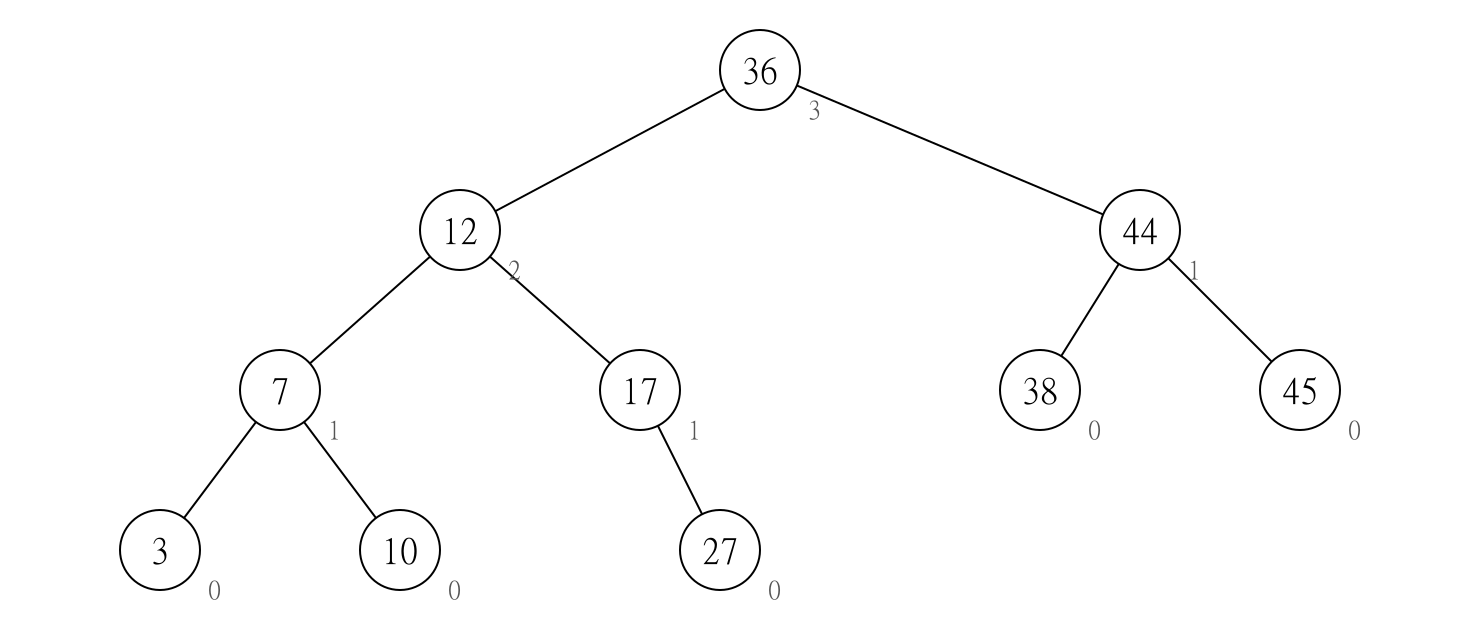
Which of the following represents the contents of the array?
Question 6
Consider the following statements about representation of a graph G with m edges and n nodes.
I. The adjacency matrix representation requires O(n3) space.
II. The adjacency list representation requires O(n2) space.
III. The adjacency matrix representation requires O(n2) space.
IV. The adjacency list representation requires O(m+n) space
Which of the statements about the graph is/are true?
Question 7
Five elements A, B, C, D, and E are pushed onto an initially empty stack in that order. The top element is then popped four times, and each popped element is immediately enqueued into an initially empty queue. Next, two elements are dequeued from the queue and pushed onto the stack, in the order in which they are removed from the queue. Finally, one element is popped from the stack. Which of the following is the element popped in the final step?
Question 8
Consider the following sequential (array) representation of a binary tree, where the nodes are stored in level-order.
| Index | 0 | 1 | 2 | 3 | 4 | 5 | 6 | 7 | 8 | 9 |
| Node | A | B | C | D | E | F | G | H | I | J |
Question 9
Which of the following correctly defines an NP-Complete Problem?
Question 10
Assume that no built-in function for exponentiation is available. Given a number x and a positive integer n, you need to compute xn using multiplication. What is the time complexity of the optimal algorithm for computing xn?
Previous papers with Data Structures and Algorithms questions
Telangana SET (TG SET) practice pack
The practice pack for Telangana SET (TG SET) is coming soon to LawMint.