
Karnataka SET (KSET) Data Structures and Algorithms Previous Year Questions
Try the preview and open any solution for a worked explanation.
Karnataka SET (KSET) practice pack
The practice pack for Karnataka SET (KSET) is coming soon to LawMint.
Question 1
Assume the following priorities in evaluating an expression (1) parentheses (2) exponentiation (3) division and multiplication (4) addition and subtraction (5) assignment. What is the equivalent post-fix expression of the infix expression a = b/c ^ d * (e + f) – g/h.
Question 2
Which of the following are true about a circular queue with array size being n (numbered from 0 to n – 1), 'f' being the index of the first element and 'r' the index of the next insertion slot, with one array slot reserved to distinguish full and empty states?
a. The Queue is full if (r + 1) mod n == f.
b. The maximum number of elements that can be stored in a Queue is n – 1
c. This is an efficient algorithm compared to linear Queue
d. This is a non-linear data structure.
Question 3
Which one of the following are true about Huffman Algorithm?
a. It is Dynamic Programming Algorithm
b. It is a Greedy Algorithm
c. Used for text compression
d. Used for image compression
Question 4
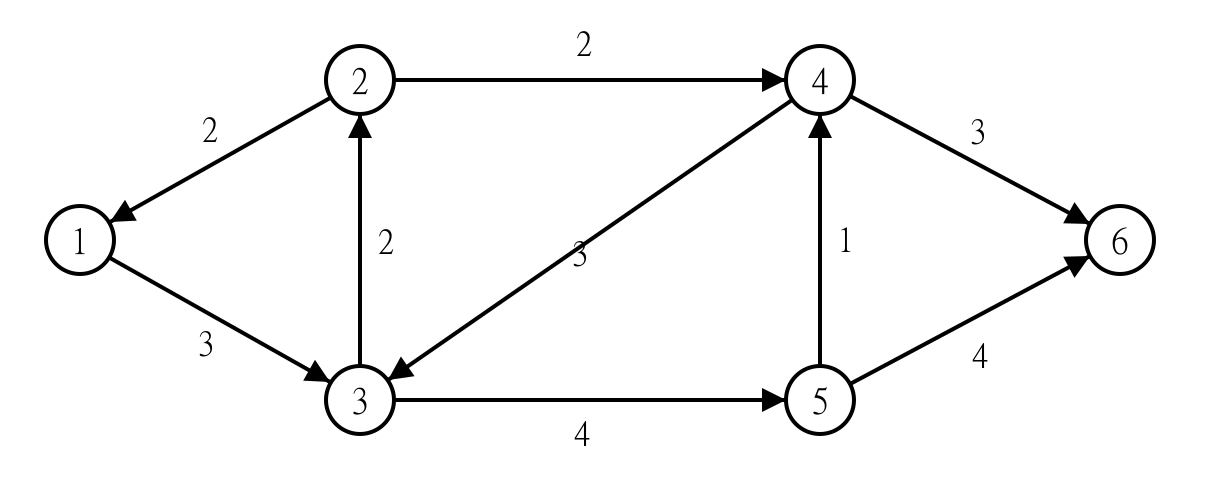
The cost of the Minimum spanning tree using Prim's Algorithm for the following graph, ignoring arrow directions, is
Question 5
Given the inorder of a tree as e, b, f, c, g, h, d and pre-order of the tree as c, b, e, f, d, g, h, the post-order of the tree is
Question 6
Which one among the following is true about a binary tree?
a. The indegree of the root is zero
b. The outdegree of a leaf node is zero
c. The maximum number of elements a tree with depth d (counting the root level as 1) can have is 2d– 1
d. Is a subset of a graph
Question 7
The complexity of brute force algorithm to find all the substrings in a given string of 'm' characters and a substring of length 'n' (where m >> n) is
Question 8
A model which uses the previously computed values for further computation is called
Question 9
Match the following:
| List-I | List-II |
| a. Prim's algorithm | (i) Dynamic Programming |
| b. Queen's problem | (ii) Divide and conquer |
| c. Quick sort | (iii) Greedy Algorithm |
| d. Binomial coefficient | (iv) Backtracking |
Question 10
In a multiprocessor environment, assume that there are n = 8 elements, and the number of processors given N = 4. If we use the Binary tree model to find the greatest of 'n' elements using parallel processing, then the time taken to find the greatest of 'n' elements is __________ (Assume the communication cost to be 0)
Previous papers with Data Structures and Algorithms questions
Karnataka SET (KSET) practice pack
The practice pack for Karnataka SET (KSET) is coming soon to LawMint.