
Jammu & Kashmir and Ladakh SET (JKSET/LASET) System Software and Operating System Previous Year Questions
Try the preview and open any solution for a worked explanation.
Jammu & Kashmir and Ladakh SET (JKSET/LASET) practice pack
The practice pack for Jammu & Kashmir and Ladakh SET (JKSET/LASET) is coming soon to LawMint.
Question 1
Consider three CPU-intensive processes, which require 10, 20 and 30 time units and arrive at times 0, 2 and 6 respectively. How many context switches are needed if the operating system implements a shortest remaining time first scheduling algorithm ? Do not count the context switches at time zero and at the end.
Question 2
Increasing the RAM of a computer typically improves performance because __________.
Question 3
Mutual exclusion problem occurs __________.
Question 4
If the disk is rotating at 3600 rpm, determine the effective data transfer rate which is defined as the number of bytes transferred per second between disk and memory. (Given size of track = 512 bytes)
Question 5
Given below are two statements, one labelled as Assertion (a) and the other labelled as Reason (r). Read the statements and choose the correct answer:
Assertion (a): A virtual memory is another name for the address space in which a job operates under demand paging.
Reason (r): Segmentation is both a memory and an information management scheme.
Question 6
Consider the following statements with respect to user-level threads and kernel-supported threads:
(i) Kernel-level threads are faster than user-level threads
(ii) For user-level threads, a system call can block the entire process
(iii) Kernel-supported threads can be scheduled independently
(iv) User-level threads are transparent to the kernel
Which of the above statements are true?
Question 7
Group-I contains some CPU scheduling algorithms and Group-II contains some applications. Match entries in Group-I to entries in Group-II.
| Group-I | Group-II |
|---|---|
| (P) Gang Scheduling | (1) Guaranteed Scheduling |
| (Q) Rate Monotonic Scheduling | (2) Real-time Scheduling |
| (R) Fair Share Scheduling | (3) Thread Scheduling |
Question 8
Which of the following is not true of deadlock prevention and deadlock avoidance schemes?
Question 9
In the following process state transition diagram for a uniprocessor system, assume that there are always some processes in the ready state:
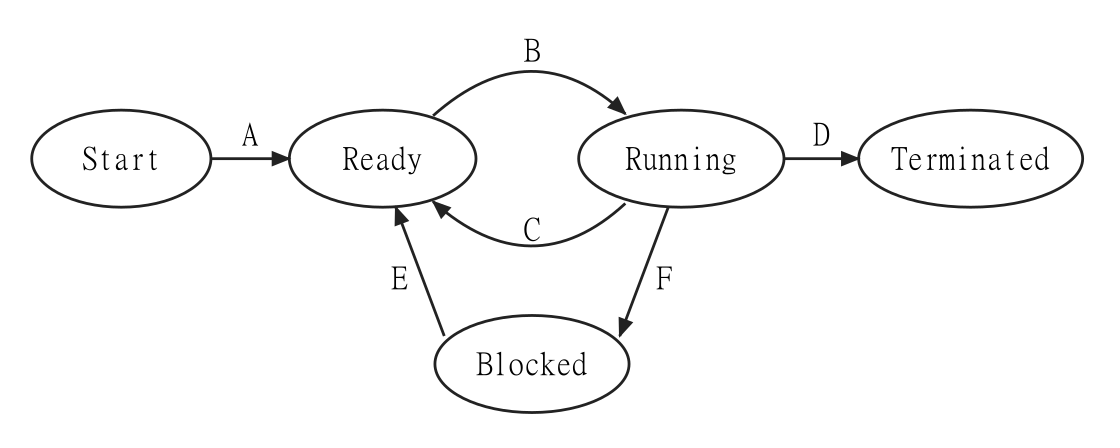
Now, consider the following statements:
I. If a process makes a transition D, it would result in another process making transition A immediately
II. A process P2 in blocked state can make transition E, while another process P1 is in running state
III. The OS uses pre-emptive scheduling
IV. The OS uses non-preemptive scheduling
Which of the above statements are True?
Question 10
Which of the following statements are true?
I. Shortest remaining time first scheduling may cause starvation
II. Pre-emptive scheduling may cause starvation
III. Round robin is better than FCFS in terms of response time
Previous papers with System Software and Operating System questions
Jammu & Kashmir and Ladakh SET (JKSET/LASET) practice pack
The practice pack for Jammu & Kashmir and Ladakh SET (JKSET/LASET) is coming soon to LawMint.