
Andhra Pradesh SET (APSET) Passage-based Questions Previous Year Questions
Try the preview and open any solution for a worked explanation.
Andhra Pradesh SET (APSET) practice pack
The practice pack for Andhra Pradesh SET (APSET) is coming soon to LawMint.
Question 1
The theory of reality is dependent on theory of knowledge. According to Nyaya system the valid and acceptable sources of knowledge have broken down Testimony. Perception is a definite knowledge which is produced by sense object contact. It is the true knowledge. Perception is of two types-one is ordinary and the other is extra ordinary. Inference is Anumana i.e. a cognition of some other knowledge. In one sense knowing is the effect from cause in which there is previous knowledge implied and in another sense cause is assumed from effect.
Comparison is Upamana. It is another source of valid knowledge. It is nothing but acquiring knowledge about something by comparing it with similarities of the other familiar things.
Testimony is the fourth source of valid knowledge. If a person heard a statement from a trust worthy person or from Authoritative texts or other sources what is known as Testimony. Other sources of valid knowledge are mainly from experience, observation, logical assumptions, authority etc.
According to the passage, the theory of reality is dependent on the theory of which of the following?
Question 2
The theory of reality is dependent on theory of knowledge. According to Nyaya system the valid and acceptable sources of knowledge have broken down Testimony. Perception is a definite knowledge which is produced by sense object contact. It is the true knowledge. Perception is of two types-one is ordinary and the other is extra ordinary. Inference is Anumana i.e. a cognition of some other knowledge. In one sense knowing is the effect from cause in which there is previous knowledge implied and in another sense cause is assumed from effect.
Comparison is Upamana. It is another source of valid knowledge. It is nothing but acquiring knowledge about something by comparing it with similarities of the other familiar things.
Testimony is the fourth source of valid knowledge. If a person heard a statement from a trust worthy person or from Authoritative texts or other sources what is known as Testimony. Other sources of valid knowledge are mainly from experience, observation, logical assumptions, authority etc.
According to the passage, which of the following statements is not true?
Question 3
The theory of reality is dependent on theory of knowledge. According to Nyaya system the valid and acceptable sources of knowledge have broken down Testimony. Perception is a definite knowledge which is produced by sense object contact. It is the true knowledge. Perception is of two types-one is ordinary and the other is extra ordinary. Inference is Anumana i.e. a cognition of some other knowledge. In one sense knowing is the effect from cause in which there is previous knowledge implied and in another sense cause is assumed from effect.
Comparison is Upamana. It is another source of valid knowledge. It is nothing but acquiring knowledge about something by comparing it with similarities of the other familiar things.
Testimony is the fourth source of valid knowledge. If a person heard a statement from a trust worthy person or from Authoritative texts or other sources what is known as Testimony. Other sources of valid knowledge are mainly from experience, observation, logical assumptions, authority etc.
The statement "Cause is assumed from effect" means
Question 4
The theory of reality is dependent on theory of knowledge. According to Nyaya system the valid and acceptable sources of knowledge have broken down Testimony. Perception is a definite knowledge which is produced by sense object contact. It is the true knowledge. Perception is of two types-one is ordinary and the other is extra ordinary. Inference is Anumana i.e. a cognition of some other knowledge. In one sense knowing is the effect from cause in which there is previous knowledge implied and in another sense cause is assumed from effect.
Comparison is Upamana. It is another source of valid knowledge. It is nothing but acquiring knowledge about something by comparing it with similarities of the other familiar things.
Testimony is the fourth source of valid knowledge. If a person heard a statement from a trust worthy person or from Authoritative texts or other sources what is known as Testimony. Other sources of valid knowledge are mainly from experience, observation, logical assumptions, authority etc.
Which of the following is opposite in meaning to the word "Similarities" ?
Question 5
The theory of reality is dependent on theory of knowledge. According to Nyaya system the valid and acceptable sources of knowledge have broken down Testimony. Perception is a definite knowledge which is produced by sense object contact. It is the true knowledge. Perception is of two types-one is ordinary and the other is extra ordinary. Inference is Anumana i.e. a cognition of some other knowledge. In one sense knowing is the effect from cause in which there is previous knowledge implied and in another sense cause is assumed from effect.
Comparison is Upamana. It is another source of valid knowledge. It is nothing but acquiring knowledge about something by comparing it with similarities of the other familiar things.
Testimony is the fourth source of valid knowledge. If a person heard a statement from a trust worthy person or from Authoritative texts or other sources what is known as Testimony. Other sources of valid knowledge are mainly from experience, observation, logical assumptions, authority etc.
Which of the following comes under other sources of knowledge?
Question 6
Study the following figure.
Trained nurses: rectangle
Married population: circle
Nurses in hospital: triangle
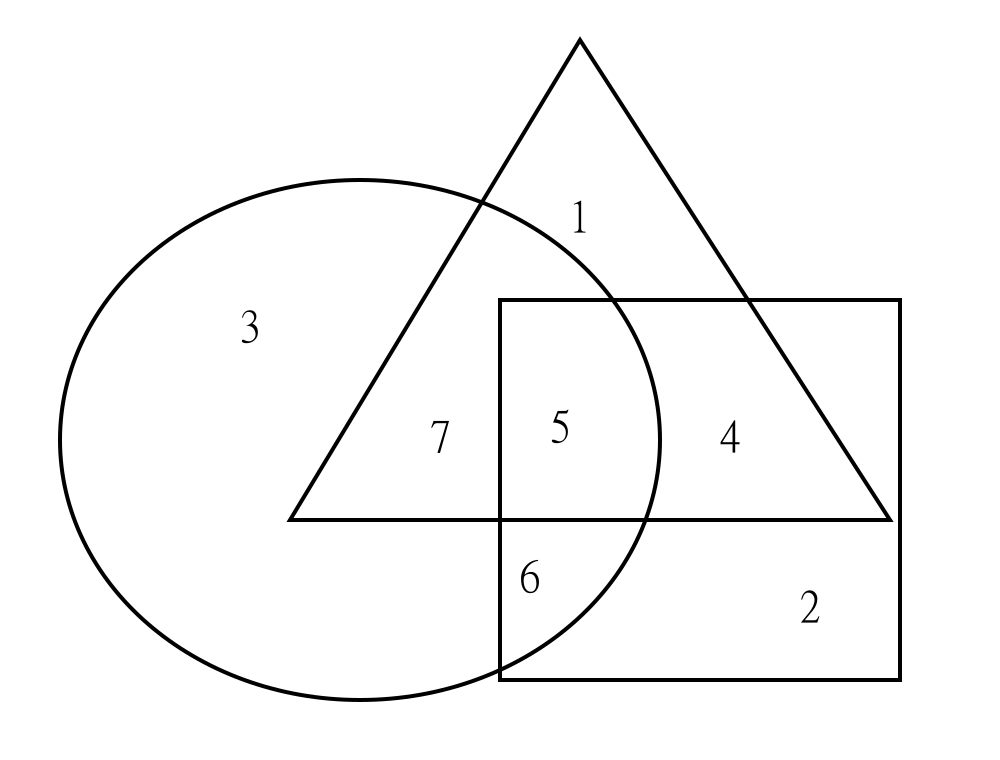
Married but untrained nurses in hospitals are represented by the number
Question 7
Study the following figure.
Trained nurses: rectangle
Married population: circle
Nurses in hospital: triangle
Which part of the diagram represents married and trained nurses in hospitals?
Question 8
Study the following figure.
Trained nurses: rectangle
Married population: circle
Nurses in hospital: triangle
The total number of Nurses in Hospital is__________
Question 9
The pie-diagram below shows the percentage of people in a town working in various organisations. The table adjoining it gives the percentage of females working in those organisations. Study this information.
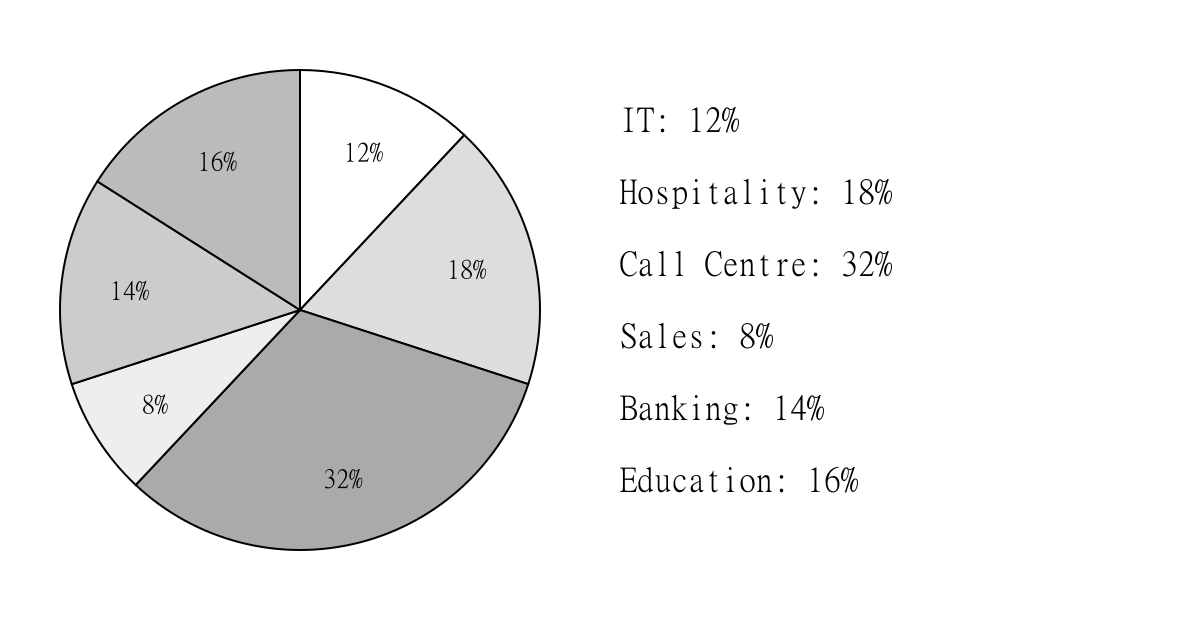
| Organisation | Percentage of females |
|---|---|
| IT | 20 |
| Hospitality | 20 |
| Call Centre | 45 |
| Sales | 60 |
| Banking | 40 |
| Education | 15 |
Total number of people: 40,250
What is the approximate average number of females working in all the organisations together?
Question 10
The pie-diagram below shows the percentage of people in a town working in various organisations. The table adjoining it gives the percentage of females working in those organisations. Study this information.
| Organisation | Percentage of females |
|---|---|
| IT | 20 |
| Hospitality | 20 |
| Call Centre | 45 |
| Sales | 60 |
| Banking | 40 |
| Education | 15 |
Total number of people: 40,250
What is the total number of men working in all the organisations together?
Passage-based Questions topics in Andhra Pradesh SET (APSET) papers
Previous papers with Passage-based Questions questions
Andhra Pradesh SET (APSET) practice pack
The practice pack for Andhra Pradesh SET (APSET) is coming soon to LawMint.